


A Short Cable Tray Guide
25th May 2026
Cable trays are an alternative to conduit, and an alternative that is often touted as a result of the numerous relative advantages they offer. Intended to be used with tray cable, cable trays are flexible, modular, versatile, and capable of offering some other superior attributes when compared to conduit. Let’s take a closer look.
What Are the Types of Cable Trays?
Broadly speaking, cable tray is a metal support for tray cable, but there are many different types of cable tray. Here are four of the most common.
- Ladder: Ladder cable tray is one of the most minimal types. It looks like a ladder with a single rail running up the middle, or sometimes rails on either side. Ladder cable tray can be one of the lightest types of cable tray and allows for some of the best heat dissipation.
- Perforated: Perforated cable tray has a solid bottom that is perforated with holes, hence the name. It offers good heat dissipation and air circulation, but not to the same degree as ladder cable tray.
- Wire mesh: Wire mesh cable trays are lightweight and some can easily be cut and bent, making them ideal for lightweight installations where adjustments may be frequently required.
- Solid bottom: Solid bottom cable tray is completely enclosed on the bottom and does not allow for the same level of heat dissipation, and it can also be heavier. However, solid bottom trays offer great protection against EMI and offer better protection against moisture and debris than other types of cable trays.
These are only a few of the most common types of cable tray. For a more comprehensive breakdown, see our previous post, Types of Cable Trays.
What Is Tray Cable?
Generally speaking, tray cable is any type of electrical wire or cable that is rated for installation in a cable tray. Depending on the environment, tray cable may need to be able to resist sunlight, chemicals, acids and bases, oil and gas, or physical abrasion. It might also need to be water resistant if it is intended to be installed in a wet environment.
What Are the Benefits of Cable Trays?
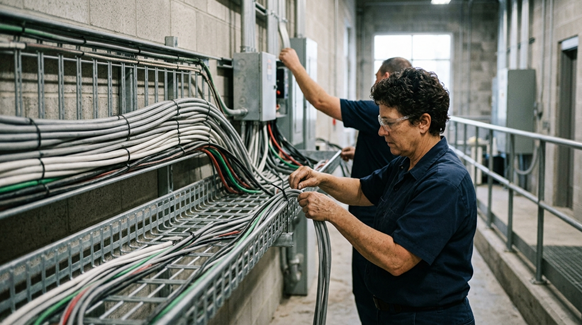
Because of their considerable differences from conduit, there are a number of very important advantages associated with the installation of cable trays. Here are some of the most important among them.
- Low-cost installation: It is easier and much more cost-effective to lay tray cable in a cable tray than it is to draw it through a conduit. There is also a higher risk of cable breakage when drawing wires through conduit which doesn’t really affect cable tray. This can save some systems administrators and facilities managers money when upgrading electrical infrastructure or installing new equipment.
- Easy maintenance: Cable tray and tray cable are generally associated with lower maintenance requirements and costs when compared to conduit. This also helps lower overall system costs.
- Streamlined inspection, repair, removal and upgrade: Once cable is drawn through conduit, it’s very difficult to access it for inspection. With cable tray, regardless of the type of tray, it’s generally very easy to inspect cable at a glance and it can be viewed anywhere along its length. This makes it significantly more practical than conduit and makes it a lot easier to replace cable that’s laid in tray than drawn through conduit.
- Greater versatility and modularity: While conduit and tray themselves are roughly equivalent in flexibility, once cable is installed in them, the edge goes to tray. This is because cables can easily be removed or rerouted, and new tray can easily be added to the infrastructure. The same cannot be said for conduit, which means that cable tray is much more flexible and offers a highly scalable alternative to tray.
- Superior heat dissipation: Conduit is necessarily enclosed whereas tray is at least partially open and in the case of wire mesh and ladder tray is largely open to the air. This makes tray the superior option if a high degree of heat dissipation is necessary, and it helps reduce heat stresses and keeps the cables cooler.
- EMI protection: While tray cable doesn’t offer the same level of EMI protection as conduit does, in some cases it can offer nearly comparable protection, as in the case of solid-bottom tray. There is also always the option to lay shielded tray cable in lighter tray, such as mesh trays, which helps solve the problem of EMI while also reducing weight.
Are There Any Drawbacks?
While cable tray is well-regarded for the benefits covered in the last section, it does have a few shortcomings when compared to conduit. Here are two of the biggest.
- Level of protection: One way or the other, cable tray does not offer the same degree of protection as conduit, either against temperature or exposure to the elements, simply because conduit is fully enclosed and cable tray is necessarily partially exposed.
- Suitability for direct burial: Conduit can be directly buried and in fact often is. Cable tray is primarily intended for open air installation, and even if it could be buried that would eliminate some of the benefits it offers over conduit, so conduit is really the only legitimate choice here.
Explore Tray Cable and More Here
Whether you’re here to learn more about cable trays and tray cable, take a look through our collection or get in touch with us to learn more. We also carry a wide range of other specialty electrical wire and cable, including but not limited to marine battery wire, welding cable, solar panel cable, DLO cable, submersible pump cable, and aluminum wire. Explore our collection and get in touch with us if you have any questions.