


Aluminum Wire vs. Copper Wire: A Breakdown by the Specifications
7th May 2026
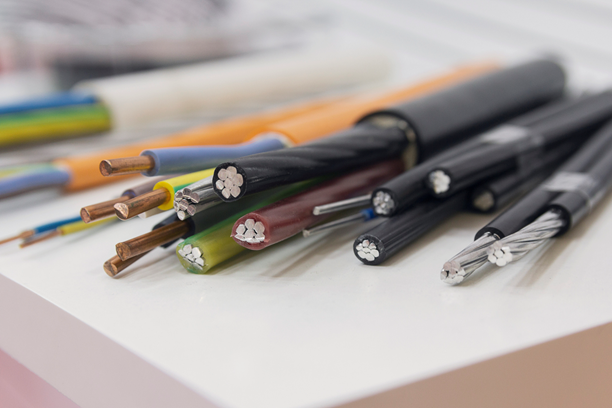
It should come as no surprise that a great deal of general purpose 600 volt wire and building wire is made from copper. At the same time, you may be aware that many specialty cables, such as triplex and quadruplex wire, are made of aluminum conductors.
But how do copper and aluminum wire really stack up against each other? This short post will break down some of the differences, by feature and specification, putting them head to head.
Weight
No matter how you look at it, copper is considerably heavier than aluminum; therefore copper wire is heavier than aluminum wire, regardless of the type of wire or the intended application.
Copper’s density is typically 8.935 g/c2, whereas aluminum’s is 2.699 g/c2. This makes copper nearly 3 times as heavy as aluminum by volume. It also means that copper weighs over 500 pounds per cubic foot. It’s a dense metal, heavier even than steel.
Consequently, the logistical and installation costs associated with copper building wire are a lot higher than those associated with aluminum. It means furthermore that it is more expensive to transport copper, and that aerial installations with aluminum are much more practical and require less rigid infrastructure, which is one of the reasons that triplex and quadruplex wire are often made of aluminum.
Flexibility and Stress Cycles
Both copper and aluminum are highly flexible and highly malleable, and light gauge wires can easily be bent into shape, and even reformed several times before they break. Aluminum is slightly easier to work with than copper but nonetheless both are highly flexible.
Even so, copper can typically withstand several more stress cycles (that is, being bent, straightened, and bent again) before it fails. In some instances, aluminum will even fatigue and snap on the first stress cycle.
This, among other things, makes copper wire considerably more durable overall than aluminum wire, which makes it preferable in some installations.
Tensile Strength
Tensile strength refers to how much pressure a wire can be subjected to when drawn before it snaps. The metallurgy of the specific alloy will influence this, but nonetheless, copper has significantly better tensile strength than aluminum.
Tensile strength is subject to whether or not the metal alloy is annealed, or whether it has been tempered and heat-treated. Naturally, tempered alloys have higher tensile strengths than annealed (or softened) alloys.
In addition, the gauge of the wire in question will also impact its tensile strength and yield strength. Nonetheless, copper has a higher tensile strength than aluminum, which further contributes to the fact that aluminum wire is less durable overall than copper.
As a result, when electrical wire and cable will be subjected to mechanical stresses, it’s preferable to use a copper wire, such as when the wire must be drawn through conduit. Also, aluminum wire has a propensity to stretch out when loaded, such as when an aerial wire is laden with snow or ice. This is why some triplex and quadruplex wires are strengthened with a non-conducting steel member that helps to prevent this.
Conductivity
Copper has better overall conductivity than aluminum, which means that if you take two wires of the same gauge, the copper wire will exhibit higher ampacity and be able to handle a current at a higher voltage than the aluminum wire without the risk of overheating.
As a result, for sensitive installations, or those in which high signal fidelity is required, such as in the case of instrumentation and alarm cable, copper is often preferred to aluminum.
Conductivity to Weight Ratio
While it is true that aluminum wire has a lower overall conductivity than copper, a caveat should be issued to the effect that if mass is taken into account, aluminum is actually better. It has a higher conductivity to weight ratio than copper.
What this means is that while copper technically does exhibit better conductivity, less mass in aluminum is needed to carry the same current at a specific voltage given, which gives aluminum the edge in some situations, such as in aerial installations as triplex or quadruplex wire.
Corrosion Resistance
Both aluminum and copper technically corrode upon exposure to oxygen (they oxidize) but as a result of aluminum’s unique properties, it is better in situations in which a higher degree of corrosion resistance is warranted.
When aluminum is exposed to an oxygen rich environment (like air) a thin layer of aluminum oxide forms almost instantaneously, and this layer stops the reaction from penetrating further into the metal.
The same thing happens with copper, except the corrosion tends to travel further and further into the metal until the entire thing decays. For this reason aluminum is generally considered more corrosion resistant than copper. It is also the reason that some copper wires, like marine grade wire, have conductors that are individually tinned.
Cost (and Theft Risk)
The costs of copper have fluctuated wildly over the past few years, so rather than giving an estimate that will be out of date in a month, suffice it to say that at the time of this publication (mid 2026) the price of copper is such that copper wire is significantly more expensive than aluminum wire. For this reason alone aluminum wire, specifically power service wire and cable like triplex and quadruplex wire, are often preferred to copper.
The price of copper also makes it a theft risk, as some vandals will break into homes and stockpiles and steal copper so that it can be resold.
Recyclability
Both copper and aluminum can be effectively recycled, making copper and aluminum wire equal on this footing.
Shop Copper and Aluminum Wire Here
Need a new wholesale supplier of copper and aluminum wire? Shop our collection, which is full of both general purpose building wire as well as specialty electrical wire and cable like solar panel cable, armored cable, instrumentation and alarm cable, and more.
Get in touch with us if you have any questions about the specifications of anything we sell. We are more than happy to help.