


The Real Reason 4/0 Welding Cable Has So Many Strands
21st Jul 2025
Take a look at our 4/0 welding cable - that’s pronounced “four-aught” for those of you that have never seen it before.
It’s one of the thickest cables we sell here at EWCS Wire, but it’s not just thick. It’s made with many, many smaller, thinner, 100% copper conductors. More than 2000, in fact.
But there’s a very important reason for this, which we’ll break down in this post.
Many-Stranded 4/0 Welding Cable
First, let’s take a closer look at some facts and figures. Our 4/0 welding cable is made with 2014 strands of 100% pure copper.
It has a nominal diameter of .720”. That’s quite thick - almost a full three-quarters of an inch thick. It’s heavy, too, and weighs nearly a half-ton per 1000’ of cable. To be precise, it weighs 734 pounds per 1000 feet of length.
To put this more clearly in perspective, imagine if this copper cable was made with one single thick copper wire rather than 2000+ strands.
Pure copper has a yield strength somewhere around 33 to 55 MPa, or megapascals. For annealed pure copper, in terms of PSI, this is somewhere around 36,000 PSI.
The force required to bend a solid copper wire is considerably higher than the force required to bend a much thinner strand. Therefore, it is much easier to bend a cable with many thin conductors than it is to bend a solid copper wire.
But here’s the catch, and it’s a good one. A cable with many thin conductors will have roughly the same voltage rating and current carrying capacity as a single conductor of the same capacity, even though it will remain significantly more flexible.
Another thing to keep in mind here is that, in addition to the fact that it would not be reasonably possible to bend a solid copper wire that was nearly a full inch thick, if you did, you would put a permanent set in the wire. And if that were not bad enough, bending it back and forth a few times would cause it to snap, which as you might imagine would not be beneficial to the welder.
This is one of the main reasons that welding cable for sale is often marketed as flexible welding cable. It is so designed that, with a higher conductor count, it remains flexible enough to be viable and useful without being so stiff that it can’t be practically worked.
Moreover, this flexibility is important because of the nature of welding cable. In many power transmission configurations, once the wire is drawn and connected within a circuit, it’s more or less static. It doesn’t need to be moved, or to flex. That is not the case with welding cable.
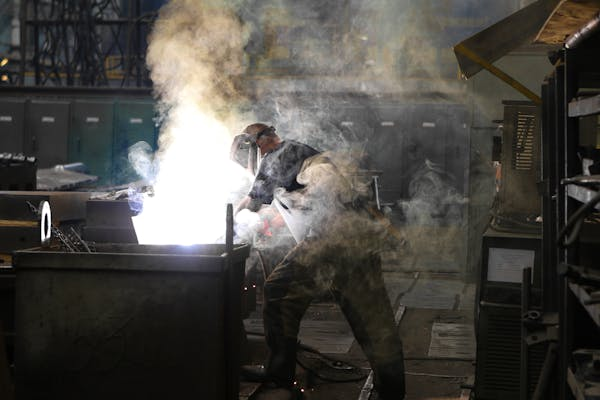
Regardless of the welding method, welding cable must remain flexible for a welder to move his or her equipment into and out of place. This is especially true in shipbuilding and construction. You can’t move the angle and orientation of a ship or a building that you’re quite literally constructing. You have to move your machinery around it, not the other way around.
That means your welding equipment, and thereby your welding cable, must remain flexible enough that it can be moved with less effort. Ultimately, this necessitates a highly flexible welding cable.
Creating a welding cable with many finely stranded conductors is simply the most effective and most practical way to do so, and it results in a cable that is not only more flexible, but capable of being used effectively for welding applications.
Also, not that this has anything to do with the flexibility of the cable itself, our welding cable is insulated with high quality EPDM rubber. This material is highly abrasion resistant and also resistant to a wide range of chemicals, along with oil and gasoline.
This, along with flexibility, is one of the defining characteristics of a high quality welding cable. Since welding must be done onsite, often with no protection against the elements, or with express exposure to adverse conditions, a high quality insulative material is needed to protect the cable.
Are There Any Other Practical Uses for Welding Cable?
In addition to being a viable option for welding applications, our red and black insulated welding cable for sale has a variety of other use cases.
For one, the color of the insulation makes it suitable for use as battery leads. The higher degree of flexibility also makes it useful in cramped engine compartments. Just don’t use it as marine battery cable; its flexibility is a bonus for that, but marine battery cable is made of individually tinned conductors that are better protected against corrosion.
Our flexible welding cable can also be effectively used as leads for motors and generators, and has a potentially special use case as solar panel cable, specifically for use in wiring inverters.
Our flexible welding cable for sale is insulated with EPDM rubber that is highly flexible and offers a great deal of resistance to environmental factors that can render it useful as welding cable. Among other things, it is resistant to abrasion, oil and gasoline, and other chemicals.
This EPDM rubber is also highly resistant to ozone along with excellent waterproofing characteristics, making it effectively weatherproof. Also notable for its potential use as solar panel cable is the fact that for a polymer, EPDM offers pretty solid resistance to ultraviolet light, something that’s a must for use outdoors.
Shop High-Quality 4/0 Welding Cable Here
Here for high-quality 4/0 welding cable? Take a look through our full collection of flexible welding cable for sale to find what you need. We also carry a wide range of other specialty electrical wire and cable, including but not limited to building wire, armored cable, DLO cable, submersible pump cable, aluminum wire, including triplex and quadruplex wire, bare copper wire, and security and alarm cable, including fire alarm cable.
Get in touch with us at Sales@EWCSWire.com or at 800-262-1598 if you have any questions about anything we sell.