

Tray Cable and Ratings
27th Jul 2026
Tray cable is associated with a wide range of advantages over drawing cable through conduit. This post, however, will dive into some of the different types of commonly encountered tray cable, what they are used for, and some of their ratings.
Types of Tray Cable
The following are some of the more common types of tray cable.
- Type TC: Type TC tray cable satisfies UL 1277 and is a 600V cable that is commonly used for power control in industrial circuits. It is often used in heavy industrial facilities such as those in the petrochemical industry as well as in mining and metal production. The NEC specifies that Type TC tray cable is typically rated to 600V but there are 1000V and 2000V options available. It is commonly used in control applications but it may also be used for lighting and signal circuits, as well as Class 1 hazardous circuits. The two most common types of insulation used with Type TC tray cable are VNTC (vinyl nylon tray cable) and XHHW (cross-linked PE cable that is resistant to water and heat).
- Type PLTC: Type PLTC, or power limited tray cable, satisfies UL 13 and is used in low-energy power-limited circuits like industrial control systems, as well as for instrumentation wiring. They can also be used for intercom and alarm systems, and other similar low-voltage installations.
- Type ITC: Type ITC, or instrumentation tray cable, is a type of PLTC cable that satisfies UL 2250. It is a specific type of tray cable that has two or more insulated copper or thermocouple alloy conductors enclosed under a nonmetallic jacket. The cable in question may also have additional insulation or armor over the nonmetallic jacket, and may also contain grounding cables. Also, this type of tray cable is typically rated to a lower voltage rating, 300V, and may be used as instrumentation cable (hence the name) but not as power cable.
- Type WTTC: Type WTTC, or wind turbine tray cable, satisfies UL 2277 and is tray cable designed to withstand the extreme conditions faced with installations in wind turbines, including but not limited to extreme temperatures and exposure to precipitation and moisture. It should also be resistant to oil, abrasion, and other harsh conditions. It is rated to 1000V and is made with insulation that offers exceptional resistance to sunlight, oil, and other environmental stressors.
Additional Tray Cable Ratings
In addition to the types of tray cable covered here, here are a few additional ratings that you may sometimes encounter in tray cable:
- ER: This stands for “exposed run” and connotes that the cable in question is rated for use in exposed runs. In other words, tray cable is designed for installation in trays, but if the cable must leave the tray for a run of more than 6 feet, it must either be armored, installed in a conduit, installed in a raceway, or have an ER rating. Using ER-rated cable can help reduce the cost of installing additional tray, using armored cable, or drawing the cable through conduit.
- DIR BUR: This stands for “direct burial” and is a rating that signifies that the cable in question may be buried in the earth and can withstand the moisture, temperature, and other factors associated with direct contact with soil without the need for conduit or additional sheathing.
- SUN RES: SUN RES, for “sunlight resistant”, is tray cable that is rated for exposure to direct sunlight. These tray cables must be made with insulation that is able to withstand exposure to the UV and other effects of direct sunlight exposure.
- OIL RES: OIL RES stands for “oil resistant” and is tray cable that is resistant to exposure to oil. OIL RES II is another rating that connotes that the cable in question can withstand exposure to oil at elevated temperatures.
Types of Cable Tray
In addition to the many types of tray cable that are out there, there are also a variety of different types of cable tray, including the following.
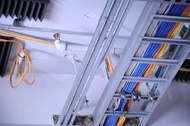
- Ladder: This cable tray looks like a ladder and has rungs; it offers robust support for heavy cables while still allowing for a high degree of airflow.
- Perforated: Perforated cable tray consists of a solid bottom with holes in it. It partially encloses the cables while still allowing for some airflow.
- Solid bottom: Solid bottom cable tray helps keep debris from contacting the cable and provides some of the highest protection among cable tray but allows for the least amount of airflow and heat dissipation.
- Wire mesh: This type of cable tray is lightweight and flexible, making it easy to install. It is not as strong as other types of cable tray, but it is relatively to handle, suitable for light wire and cable, and it still offers a good degree of airflow.
Why Tray Cable in the First Place?
There are numerous advantages of installing electrical tray cable in trays as opposed to drawing cable through conduit. Here are some of the best of them.
- It is more cost-effective to use cable tray, as it is expensive to draw wires through conduit and sometimes wires break.
- Once the wires are installed, it is easier to inspect and replace them in tray than in conduit.
- Tray is more versatile and modular, making it better in installations where changes will need to be made down the road.
- Tray allows for better heat dissipation than conduit.
- Some types of tray still provide a good degree of physical and electromagnetic shielding to cable.

Explore High-Quality Tray Cable for Sale at EWCS Wire
Hopefully you found this guide to the types of tray cable, their ratings, and cable tray informative and helpful. If you still have questions, you can get in touch with us directly and we would be more than happy to assist.
Otherwise, consult our online catalog, which contains a wide variety of specialty electrical wire and cable, including tray cable, and bookmark our page if you need another wholesale electrical wire supplier.