

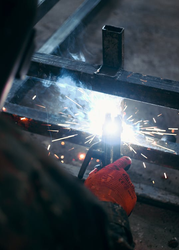
Types of Welding, and Their Applications
9th Feb 2026
As a welding cable supply specialist, we know a few things about what our wares are used for. Here are some of the more common types of welding, how they are used, and a little general information regarding welding cable.
TIG Welding
TIG welding, for “tungsten inert gas” welding, is a very versatile technique that can be used to weld many different types of metal, including but not limited to steel, brass, copper, bronze, and aluminum.
In TIG welding, a tungsten electrode shielded by an inert gas (hence the name) creates the heat that is used to create the physical weld between the two pieces.
However, it is an advanced technique that requires both hands and a special skillset; in TIG welding, one hand feeds the welding rod while the other holds the TIG torch, which creates the heat and arc which are used to actually fuse the metals.
MIG Welding
MIG welding, which stands for “metal inert gas,” like TIG welding, using a metal electrode shielded by an inert gas to create high temperatures necessary to weld two pieces together. However, unlike TIG welding, it is much easier to learn to do.
In MIG welding, a molten metal, usually aluminum or steel, is fed through a wire feeder to the weld area, where it joins the seam of the workpiece. It is a much more common process than TIG welding, and is more economical and accommodating of a wider range of skill levels.
MIG welding can be performed with a wide range of metals but is limited in the sense that it cannot be done overhead as it relies on a gravity feed.
Plasma Arc Welding
Plasma arc welding, also known as PAW welding, generates very high heat in a very concentrated space, which makes it practical and effective for welds needed on small workpieces, such as microchips, medical devices, and other items that are heat sensitive. It is also used on steel tubing and other small metal components.
In plasma arc welding, gas is heated in the welding wand until it dissociates and becomes a plasma, which is then ionized and allows the arc to be created, melting and fusing the base metals of the workpiece.
Stick Welding
Stick welding, also known simply as “arc welding,” is one of the oldest types of welding. In stick welding, a welding electrode, typically an iron electrode, is used to produce heat that melts and welds the base metals. It is commonly used on steel but stick welding can be used with other base metals as well.
Because of its simplicity, low-cost, and accessibility to beginners, stick welding is still fairly commonly practiced despite the fact that the technique was developed over 100 years ago.
Flux-Cored Arc Welding
In flux-cored arc welding, also called FCAW, uses an electrode covered in flux to weld the workpiece; this type of welding is performed because the use of flux reduces the chance of slag inclusion into the weld, which would weaken it.
Laser Beam Welding
Laser beam welding is a unique type of welding that uses the application of a laser beam to directly heat the workpiece at the seam so that the two pieces can be joined. It is also one of the types of welding that can not only be used on a variety of base metals, but on thermoplastics as well.
Electroslag Welding
Electroslag welding, also known as ESW, is an advanced process that is used to join thin metal plates together at their margins. Because of the level of precision and delicacy required, this is one welding discipline that is typically performed by a machine, and which is automated.
About Welding Cable
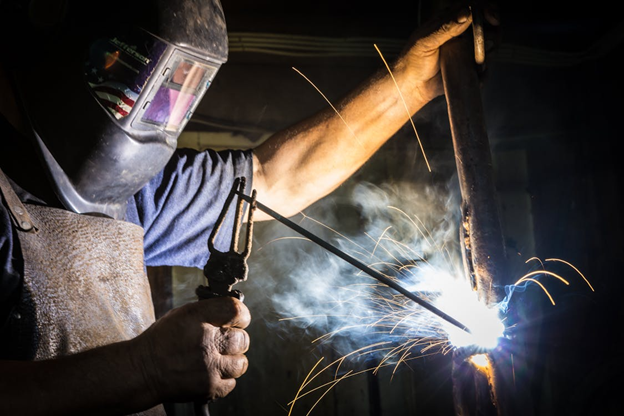
Here at EWCS Wire, we sell welding cable that is used in a variety of welding applications, and there are a few features that are unique to welding cable that should be recognized, as they make it appropriate for welding cable to be used for that very application.
One is that the cable itself should be made with a high strand count of many finely stranded conductors. This keeps the cable extra flexible, even at thick gauges like 4/0 welding cable. It enables the welding to flex the cable as needed so that the equipment can reach the workpiece in situ.
The other is that welding cable should be made with a physically durable insulative jacket that protects it not just against abrasion, but against UV, weather, and chemical attack. Many high-quality welding cables are also oil and gas resistant, which makes them better-suited to resist the rigors of exposure on a jobsite.
EWCS Wire: A Welding Cable Supply Specialist
Need a new welding cable supply partner? Take a look through our catalog and if you have any questions about what we sell, get in touch with us directly and we will be more than happy to help.